Monday, 25 April 2016

1,3,5-Trichlorohexahydrotriazine

1,3,5-Trichlorohexahydrotriazine (C3H6N3Cl3) is a mildly energetic compound prepared from hexamine. It's a yellow-white solid which generates chlorine on contact with hydrochloric acid. It's also a very unstable compound. Aside from this, not much is known about it.

To synthesize it I started with 2.7g of hexamine which I dissolved in 25ml of water in a beaker. To a separate beaker I added 60ml of  5% sodium hypochlorite solution and 80ml of 5% acetic acid. I then poured the hexamine solution into the hypochlorite/acetic acid mix. Immediately a white precipitate of the product formed.

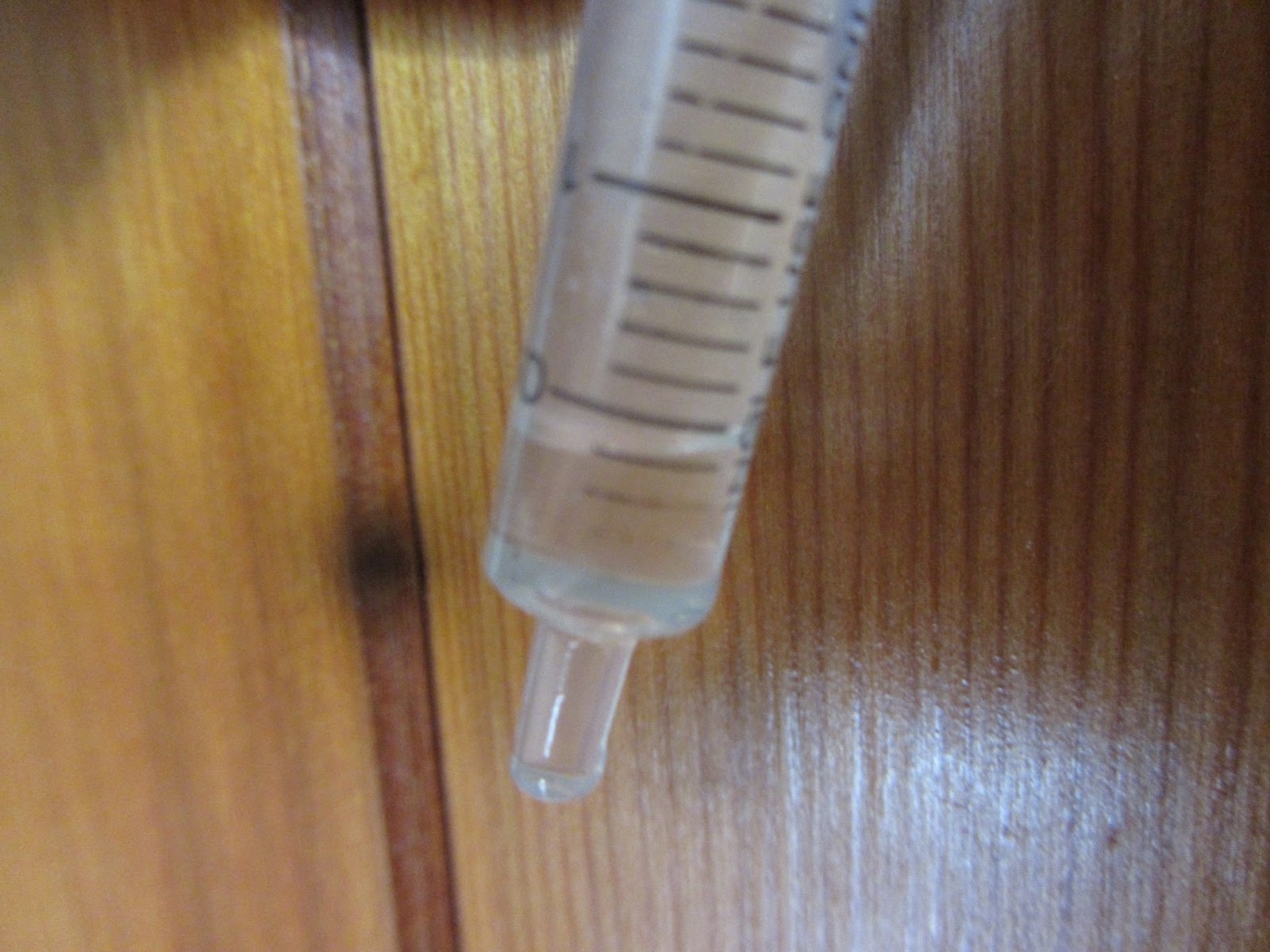
The precipitate was filtered off. The product tends to decompose to a yellow oil while drying. So every time I try drying the product, it completely decomposes and I am left with nothing. Here's a picture of some wet 1,3,5-trichlorohexahydrotriazine:


I'm not sure what the equation is sadly.

Wednesday, 20 April 2016

Bromoform

Tribromomethane or bromoform is a toxic brominated hydrocarbon. It's analogous to chloroform but with the three chlorine atoms replaced with three bromines. Its not a very useful compound to have but its still interesting. I made some because I had recently obtained some sodium bromide and wanted to use it for something.

I chose to use the haloform reaction to make bromoform.

To make bromoform I started by adding 10g of sodium bromide and 150ml of water to a conical flask. I then poured in 205ml of 5% sodium hypochlorite bleach. The mixture was stirred, and I added 4ml of acetone with 10ml of water. I stirred the mixture well, then set it aside for 5 hours. After this, little drops of bromoform could been seen at the bottom of the flask. I shook the flask and the drops of bromoform came together into a homogeneous liquid. The little layer of bromoform at bottom was collected with a syringe. I determined I had 0.6ml of bromoform which is a 12.5% yield.


If you look carefully you can see the lower bromoform layer.

I attribute my terrible yield to a lot of the bromoform drops not collecting together as well as my clumsy collection of the product with the syringe.

NaBr + NaOCl ==> NaOBr

(CH3)2CO + 3 NaOBr + H2O ==> CHBr3 + CH3COOH + 3 NaOH

Monday, 18 April 2016

Chromium chlorate

Chromium(iii) chlorate is a slightly soluble inorganic salt with the formula Cr(ClO3)3. I chose to make some chromium chlorate because I could find almost no information on it and I was curious about what it would be like.

 I knew copper(ii) chlorate was very soluble, so I thought chromium(ii) chlorate would be as well. I tried adding a solution of chromium(ii) sulphate to a solution of calcium chlorate. I hoped that calcium sulphate would precipitate and I would be left with a chromium(ii) chlorate solution. A precipitate did form, but it was a blue-green color so I knew it couldn't be purely calcium sulphate.

I decided to give chromium(ii) chlorate a break and try making chromium(iii) chlorate.

I prepared a chromium(iii) chloride solution and to it I added a solution of calcium chlorate. A navy blue precipitate of chromium(iii) chlorate formed! The same precipitate formed when sodium chlorate was used in place of calcium chlorate. Anyway I filtered off the chromium(iii) chlorate and dried it. Success!


left = dried chromium(iii) chlorate / right = pyrotechnic with chromium(iii) chlorate and Mg
2 CrCl3 + 3 Ca(ClO3)2 ==> 3 CaCl2 + 2 Cr(ClO3)3

2-Benzoxazolinone

2-Benzoxazolinone or 2-(3H)-benzoxazolone is an organic compound used as a precursor to several insecticides. It has quite an interesting structure (in my opinion anyway). I plan to use 2-Benzoxazolinone to make 2-aminophenol.

2-Benzoxazolinone can be made from salicylamide. I tried this out.

To a 225ml conical flask, I added 3.4g of crude salicylamide and 100ml of water. I then placed this in an ice bath to cool down. To a separate vessel, I added 50ml of water, 3g of sodium hydroxide and 13ml 4% sodium hypochlorite bleach. The sodium hydroxide prevents ring chlorination. Anyway, once the salicylamide mixture had cooled to 7 C, I started to slowly add the bleach mix in 5ml portions with strong stirring. It's very important that the temperature is low. Once the bleach addition was complete, I added 15ml 10% sodium hydroxide solution and heated the mixture to 70 C for 30 minutes. After this I chilled the mixture down again in the ice bath.

Once the temperature had fallen to 8 C, I added 25ml of 33% hydrochloric acid. A fluffy brown precipitate of 2-benzoxazolinone formed. I filtered the product off and dried it. I was left with 1.8g of 2-benzoxazolinone which is a 54% yield. Not a bad day's work!


For how the reaction works see this
http://www.sciencemadness.org/talk/files.php?pid=416184&aid=42761

Monday, 11 April 2016

Copper carbonate

Copper carbonate is a nicely colored copper salt used as a pigment. Its formula is often stated to be CuCO3 but Cu3(OH)2(CO3)2 and (Cu2(OH)2CO3) are closer to the truth. I plan to use it to catalyze the decarboxylation of niacin to pyridine, as well as to make calcium copper silicate.

Copper carbonate is relatively easy to make. I made some.

To a 500ml beaker I added 20g of copper sulphate pentahydrate and 150ml of water. The mixture was stirred to give a clear blue solution. With strong stirring, I slowly added 20g of sodium bicarbonate. As I added the sodium bicarbonate, the mixture started foaming and a wonderful green-blue colored precipitate of copper carbonate gradually formed. Once all the sodium bicarbonate had been added, the mixture was filtered to collect the copper carbonate product. After drying, I was left with 31g of copper carbonate.


NaHCO3 + CuSO4 ==> Cu(HCO3)2 + Na2SO4  /  Cu(HCO3)2 ==> CuCO3 + H2O + CO2

Wednesday, 6 April 2016

Calcium hydroxide

Calcium hydroxide, commonly called slaked lime or caustic lime, is a compound used in cement and to treat sewage. It is slightly soluble in water, and saturated solutions are called limewater. I am interested in using calcium hydroxide as a catalyst for the production of diacetone alcohol.

 Calcium hydroxide can be easily made from sodium hydroxide and calcium chloride. I tried this out.

To a 500ml beaker I added 27g of calcium chloride, then just enough hot water to dissolve it. I set the beaker aside. Then to a 250ml flask I added 20g of sodium hydroxide and a sufficient amount of water to dissolve it. Once the calcium chloride and sodium hydroxide had dissolved into solutions, I added them together. A dense white precipitate of calcium hydroxide formed. I filtered the calcium hydroxide off and dried it in the sun. This yielded 22g of calcium hydroxide in the form of a white powder. The photo was taken before the calcium hydroxide was fully dry.


CaCl2 + 2 NaOH ==> Ca(OH)2 + 2 NaCl

Thursday, 31 March 2016

Ammonium nitrate

Ammonium nitrate is an interesting compound used in the explosives industry and as a fertilizer. It's a major component of the industrial explosive ANFO. Ammonium nitrate is also used in some coldpacks. I plan to use ammonium nitrate to make nitroguanidine, and eventually aminotetrazole. The cheapest way to obtain ammonium nitrate is to extract it from fertilizers or coldpacks, however, I didn't do this.

I tried making some ammonium nitrate from potassium nitrate.

To a 1000ml beaker I added a solution of 46g of sodium bisulphate in water. Then I added 34g of potassium nitrate in solution. I stirred the mixture well. The pH of the mixture was acidic and I added ammonia solution untill the pH became neutral. I transferred the mixture to a hotplate and boiled it down until I could see crystals forming. This was potassium sulphate. The mixture was chilled down in the freezer and more potassium sulphate crystals precipitated. I filtered all the precipitate off and collected the clear filtrate.

The filtrate was allowed to evaporate, yielding 65g of slightly wet ammonium nitrate.


NaHSO4 + KNO3 ==> HNO3 + KNaSO4   //   HNO3 + NH3 ==> NH4NO3